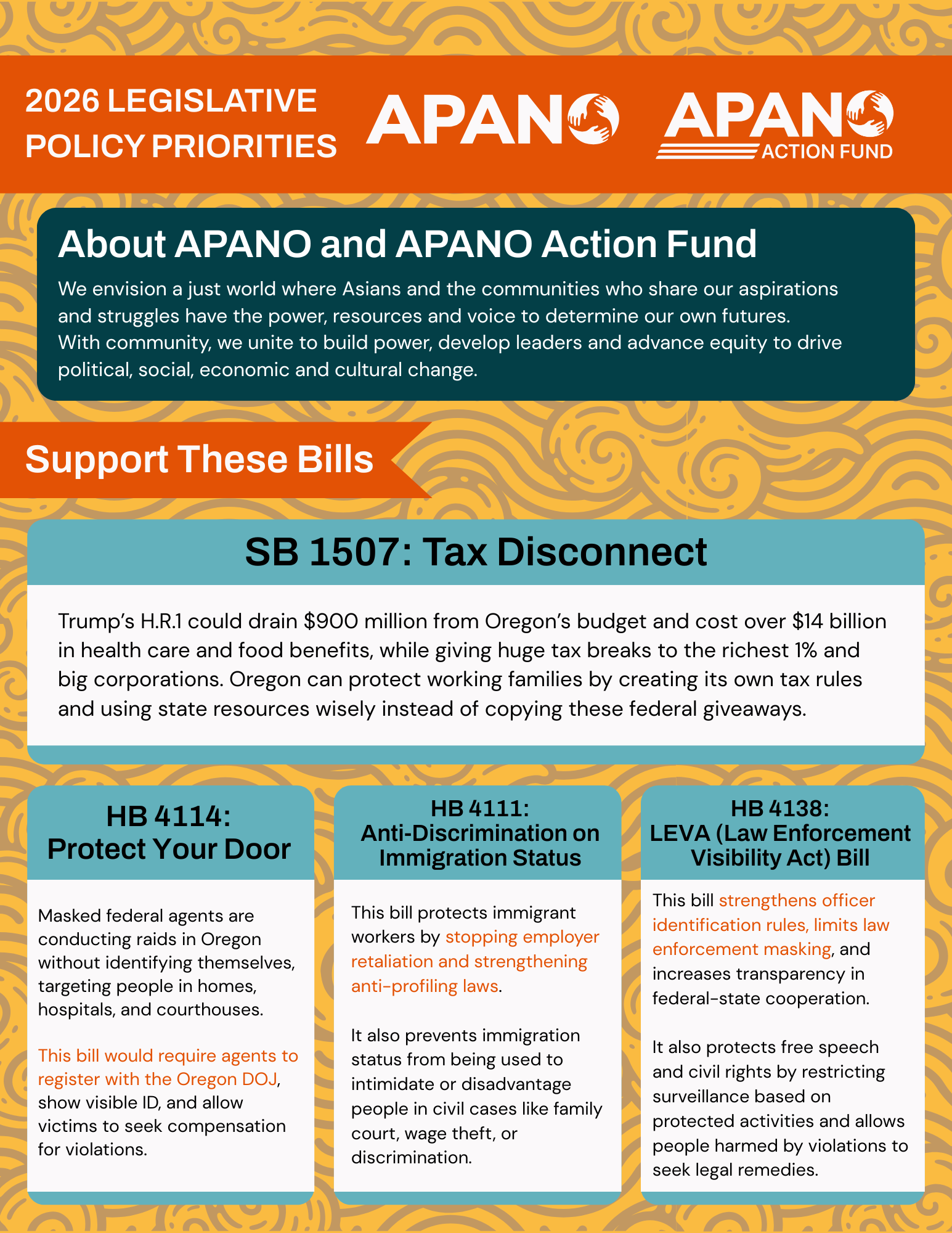
[Check out APANO’s Policy Priorities for the 2026 Legislative Short Session here.]
On Monday, Oregon's legislative session begins. And let's be clear about what's at stake: this isn't just another budget year. This is a moment that will define whether Oregon's leaders truly fight for working families, or whether they choose to balance the budget on our backs while protecting tax breaks for the ultra-wealthy.
Last session, we saw what happens when political will falls short.
Despite a Democratic supermajority, lawmakers acted as if their hands were tied — choosing caution over courage, incrementalism over impact.
They brought excuses. We brought solutions.
This year, we're demanding something different: real leadership.
Oregon is projected to lose over $1 billion in the current budget cycle thanks to HR 1 — the Trump’s tax giveaway to the wealthy.
Meanwhile, the richest 1% of Oregonians are expected to get a $42,000 tax cut, while the lowest-earning 20% get just $70.
Read that again. $42,000 versus $70.
The consequences are devastating and immediate:
- 236,000 to 363,000 Oregonians are at risk of losing health coverage through the Oregon Health Plan over the next decade
- 340,000 Oregonians will lose or see reduced SNAP benefits due to a $435 million reduction over two years, increasing child hunger and putting rural food banks at risk
- The expiration of the premium tax credit could leave tens of thousands of Oregonians paying $1,500 to $5,500 more per year for health coverage
- $88 million gap in funding for the Employment Related Day Care program means it will run out of money in January 2027, leaving 12,000 families without access to child care.
Despite these devastating impacts, here is what most legislators aren’t telling you: we have options.
Hundreds of millions of dollars are up for grabs if our legislators have the political courage to claim them.
Oregon doesn't have to automatically follow Congress's giveaways to the ultra-wealthy. We can selectively disconnect from federal tax code provisions that drain our state revenue while enriching investors and corporations. We can close loopholes. We can make wealthy business owners and corporations hiding profits overseas pay what they owe.
Here's what's possible if lawmakers choose working families over corporate donors:
Stop Federal Tax Breaks for Wealthy Investors
- Disconnect from Opportunity Zone capital gains tax breaks: $17 million/year starting in 2027
- Disconnect from Qualified Small Business Stock exclusion: $35 million
Prevent Generous New Tax Breaks for Corporate Investments
- Disconnect from bonus depreciation: $214 million
- Disconnect from Section 179 expensing: $22 million
- Disconnect from Qualified Production Property: $68 million
- Disconnect from Research & Experimentation expensing: $81 million
These tax breaks reduce Oregon revenue even if the investment happens outside of Oregon. Why are we subsidizing corporate investments in other states?
Make Corporations That Hide Profits Overseas Pay What They Owe
- Disconnect from Foreign-Derived Deduction Eligible Income (FDDEI): $67 million
- Increase Net CFC Tested Income inclusion from 20% to 50%: $121 million
End Other Poorly Designed and Regressive Tax Breaks
- Keep the SALT deduction capped at $10,000: $35 million
- Disconnect from auto loan interest deduction: $32 million in 2026, $62 million in 2027
- Disconnect from mortgage interest deduction for vacation homes: $9 million
End Oregon's Tax Break for Wealthy Business Owners
- Eliminate or deeply reduce Oregon's reduced tax rates for certain pass-through business owners: $20-145 million
Add it all up, and we're talking about hundreds of millions of dollars that could protect critical services instead of padding the pockets of wealthy investors and out-of-state corporations.
And we're not done. Oregon has reserves specifically designed for moments like this. During COVID-19, legislators strategically tapped reserves to minimize harm to Oregon families. We face another crisis today in the form of unprecedented federal attacks on everyday people. It would be malpractice not to strategically use these resources to prevent deep cuts.
Here's something that should terrify every working parent in Oregon: the Employment Related Day Care (ERDC) program will run out of money next January if our elected officials don't act.
ERDC helps low-income working families afford child care so they can keep their jobs. Without it, parents face an impossible choice: quit work to care for their kids, or pay for child care they can't afford.
We need $88 million to keep this program running. Not $88 billion. Not some impossible number. $88 million — money that's sitting on the table in the tax loopholes and corporate giveaways outlined above.
The question isn't whether we have the resources. The question is whether our leaders have the courage to claim them.
Last session, Governor Kotek and Democratic leadership didn't just fail to invest in child care — they actively cut $65 million from the Department of Early Learning and Care. They worked behind the scenes to undermine Multnomah County's voter-approved Preschool for All program. They treated early care and education like an afterthought.
This cannot happen again.
At APANO, we're on the ground every day seeing what happens when the child care system fails. We're running child care provider cohorts in Chinese and Vietnamese, helping trusted community caregivers navigate a licensing system that was never designed for them. We're watching parents work multiple jobs and still struggle to find affordable, culturally responsive care. We're organizing with the Child Care for Oregon coalition to build something this state has never had: a statewide, culturally adept child care system that actually meets the needs of families.
But we can't do this alone. We need our elected officials to lead.
We're not here to ask nicely. We're here to demand that our leaders use every tool at their disposal to protect Oregon families from federal attacks and invest in our communities' futures.
Last session, we heard a lot of excuses:
- "The budget is tight."
- "We don't have the votes."
- "It's not the right time."
- "We'll get to it next session."
Meanwhile, corporations recorded record profits. Wealthy investors got their tax breaks. And working families got left behind.
This session, we're calling BS.
Oregon's lawmakers have a Democratic supermajority. They have reserves. They have hundreds of millions of dollars in potential revenue from closing tax loopholes. They have solutions sitting on their desks, backed by statewide coalitions and years of community organizing.
What they need is political courage.
Because here's the truth: our hands are not tied. Every choice to protect a tax break for wealthy investors is a choice not to fund child care. Every choice to preserve a loophole for out-of-state corporations is a choice to cut health care. Every choice to play it safe is a choice to abandon the families who are counting on them.
We refuse to accept that balancing the budget on the backs of working families is inevitable. We refuse to accept that immigrant communities, low-income parents, people with disabilities, and our elders should pay the price for federal attacks while the wealthy get richer.
APANO is a nonpartisan organization, but we are not neutral when it comes to justice. We're tracking every vote, every decision, every moment when our leaders choose between courage and caution.
Last session, we released our first-ever Legislative Scorecard — pulling back the curtain on how legislators actually voted when it counted. This session, we're watching even more closely and aren’t making any legislative endorsements until after we see where our legislators land on critical bills.
Because 2026 is a primary year. And voters are paying attention.
The communities we organize with — immigrant families, working parents, young people, and everyone fighting for a more just Oregon — deserve to know who's fighting for them and who's just playing politics.
Monday isn't just the start of the legislative session. It's the start of our fight.

Here's how you can join us:
- Stay informed: Sign up for APANO's updates.
- Contact your legislators: Tell them you expect them to close tax loopholes for the wealthy and fully fund ERDC. Use these links (with templates ready to go) to directly email your representatives:
- Share your story: If you've been impacted by child care costs, federal benefit cuts, or rising costs, we want to hear from you.
- Show up: Join us for advocacy days, community meetings, and actions throughout the session.
- Spread the word: Share this blog and help others understand what's at stake.
Oregon's 2026 legislative session will be defined by choices — not by circumstances.
Our leaders can choose to fight for working families, or they can choose to protect tax breaks for the wealthy.
They can choose to fully fund child care, or they can choose to let the ERDC program collapse.
They can choose courage, or they can choose excuses.
We're demanding courage.
Because our communities have already survived federal attacks, rising costs, a global pandemic, and decades of disinvestment. We've organized, we've mobilized, and we've brought solutions to the table.
Now it's time for Oregon's leaders to do their jobs.
The resources are there. The solutions are clear. The only question is: Will they lead?
Curious what specific bills we’re supporting this session? Here is a breakdown:
- SB 1574 Vote 17
- SB 1581 School Meals for All
- SB1582 Virtual Power Plants
- SB 1546 AI Chatbots
- SB 1541 Make Polluters Pay (MPP)
- HB 4138 LEVA (Law Enforcement Visibility Act) Bill
- HB 4057 ODHS Referral for Families on Programs
- HB 4111 Anti-Discrimination on Immigration Status
- HB 4114 Protect Your Door
- Funding the ERDC Budget Shortfull
- HB 4125 Revenue Forecast Moderinization Act
- HB 4143 Recourse Act
- HB 4015 Tax Disconnect
- OPPOSITION: HB 4102 Pollution Permits
To learn more, check out our APANO Policy Slate for a rundown of each bill.
Latest articles
Browse all articles.png)
BIPOC Mental Health Summit Workshops